
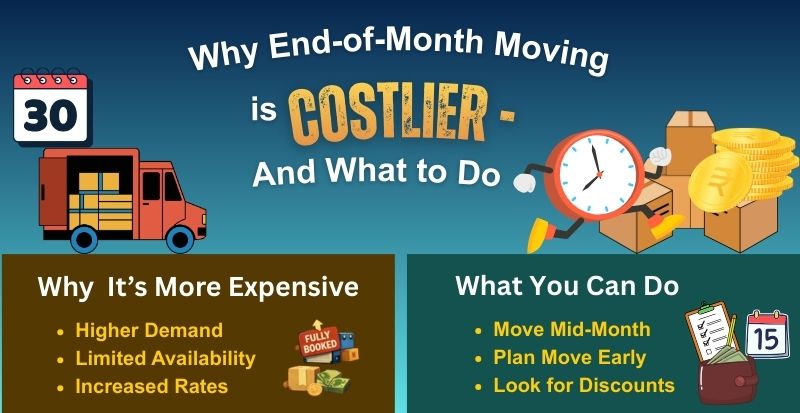
Have you ever tried booking packers and movers at the end of the month? If yes, you already know something feels off. The quotes are higher. The availability of movers is worse. And the whole experience is more chaotic than it needs to be. Here’s exactly why that happens and what smart renters do instead.
Month-End Moving Problems are Real and Expensive
Luckily, you found a good rental apartment within your budget. You smartly negotiated the rent down by a thousand rupees and are feeling good about yourself. Next, you paid the token advance and shook hands with the broker, who took his cut without blinking. The good thing is that you have a nice place to live.
What next? Even after finding the next home, your problem does not end. Now you need to book a mover to shift your belongings from your current home to your new one. And the move-in date on your agreement? The 1st of next month—a big-big headache—which means you are moving on the 31st.
Every time you call a shifting service provider, they’re either unavailable or quoting you an amount that makes you want to sit down. This is the end-of-month moving trap. It’s real and widespread across Indian metros. It costs renters thousands of rupees every single time, quietly, without anyone explaining why.
Why Indian Lease Cycles Create Peak Moving Dates
Rent agreements in India follow an established structure: monthly rent, payable on the 1st of every month. Whether you’re living in a rented flat in Delhi’s Mayur Vihar, a 3BHK in Bengaluru’s HSR Layout, or a PG in Pune’s Kothrud, the lease logic remains the same. Move in on the 1st and pay the rent by the 5th. And when you have to vacate, the notice period ends at the close of the month.
Landlords like this structure, residential societies demand it, and property managers structure their entire workflow around it.
The consequences? At the end of each month, hundreds of households in major Indian cities are simultaneously packing, vacating, and calling packers and movers. Everyone is searching for the same trucks, the same labor teams, the same lift access windows, and the same neighborhoods.
This is a straightforward case of supply and demand, which you might have learnt in school but forgot when planning your move. And when demand surges without an increase in supply, the prices go up every time.
How Much More Does End-of-Month Moving Actually Cost?
Let’s be specific, because vague warnings don’t help anyone plan a budget.
Packers and movers in Indian metros openly charge peak-day premiums. A standard 1BHK move within the same city that costs Rs. 4,000 to Rs. 8,000 on a mid-month weekday can inflate the cost to Rs. 6,000 to Rs. 12,000 or more on the 29th, 30th, or 31st. That’s a premium of 30% to 50% for the same distance, the same furniture, and the same number of boxes.
In cities like Bengaluru, Mumbai, Hyderabad, and Gurugram, where tech sector job changes create a near-constant churn of relocating households, the end-of-month squeeze is particularly severe. Moving companies know that demand is inflexible at that point. You’ve already committed to vacating and don’t have much choice.
So, movers price accordingly.
The availability of tempo and mini-truck collapses
If you are arranging transport through a local tempo service found via JustDial or a neighborhood WhatsApp group, availability dries up sharply in the last five days of the month. Available drivers are often running multiple jobs back-to-back, arriving late, tired, and with limited patience for last-minute changes.
Double rent during overlap
I have paid rent on two flats simultaneously for a month because the new lease started before the old one formally ended. This is not just a case with me; many families often face it. End-of-month moves make this worse. If your move is delayed by even one day due to manpower unavailability or a tempo breaking down, you will need to pay for at least one week in both places.
Society and lift conflicts
Most residential societies have rules about the freight lift usage and designated moving hours. On end-of-month weekends, many families complete the same lift window. As a result, moves get delayed, and movers sit idle on your hourly bill. One family’s delay can cause the next family’s problem.
Packing materials costs rise, too
Cardboard boxes, bubble wrap, and cello tape go out of stock or quietly increase in price near local packing supply shops during peak moving windows. It sounds minor until you are scrambling at 10 PM, trying to find boxes for your kitchen.
How to Avoid End-of-Month Shifting Costs: 8 Practical Tips
Save yourself the trouble of paying costly end-of-month moving premiums by learning these eight simple strategies.
1. Negotiate a Mid-Month Move-in Date When Signing the Lease
This is the single most effective intervention and the one almost nobody attempts.
When finalizing a new rental agreement, the move-in date is often more flexible than tenants assume. If a flat has been empty for two or three weeks, many landlords will be happy to accept a move-in date on the 10th or 15th instead of the 1st. This is especially true if the tenant seems trustworthy and the landlord is tired of covering utility costs for an empty place.
Some landlords charge rent only for the days you actually live in the property during the first month. Others require payment for the full month. Either way, moving on a weekday in the middle of the month is usually much cheaper than moving on a busy month-end weekend, often saving you more than the difference in pro-rated rent.
Ask the question directly—even if the broker resists. Ask anyway.
2. Move on a Weekday Whenever Possible
Most renters attempt to move on Sundays because it’s the only day when they don’t need to ask for leave. Packers and movers companies know this. Month-end Sundays are the most expensive, most crowded, and most chaotic days on the calendar.
If you can take a Friday off, or even a Thursday, and the time the move to mid-month, you will find better pricing. You will have better moving crews. And your movers will show up on time because they are not running five jobs in one day.
3. Book Packers and Movers at Least Three Weeks in Advance
For an end-of-month move, booking two to three weeks ahead is not excessive caution. It is simply how you avoid the worst of it.
Reputable moving companies, whether you found them through Moving Solutions, JustDial, Sulekha, or direct referrals from neighbors, fill their peak-day slots before demand spikes. Companies that are still available four days before the month-end are sometimes excellent. But sometimes, they are available precisely because they have not built enough trust to fill their calendar early.
Lock the rate down in writing. At least get it confirmed in a WhatsApp message. Something documented. Something you can prove. Verbal commitments on peak moving days are worth very little.
4. Call and Negotiate the Quote Directly
Usually, packers and movers quotes have much more room for negotiation than their initial numbers suggest.
Call a moving company and ask for their rate on the 30th. Then, ask what the rate would be on the 15th. Let them spell out the difference by themselves. After that, use that figure as a bargaining chip, either to push the peak-day rate down slightly or to genuinely rethink your decided moving day.
Moving companies that want the business will negotiate. And companies already overbooked won’t bother. Either way, you receive valuable insights to help you make an informed decision.
5. Use the Labor-Only or Hybrid Approach
When moving, you can separately arrange tempo transport and loading labor rather than booking a full packing and movers package. Platforms like Moving Solutions, local tempo unions, and neighborhood contacts make this easy to do. You get the vehicle from one place, hire two or three helpers for loading/unloading from another, and handle the logistics on your own.
This approach requires more effort but can reduce total moving costs by 35% to 50% compared to a full-service mover on a peak day. It’s extremely good for 1RK to 2BHK flats, where the volume of goods is quite small.
6. Declutter Aggressively Before Moving Day
Families tend to keep their old appliances that partially work, vases inherited from the previous generation, and furniture that was only ever supposed to be temporary. The accumulation of stuff is very common in Indian households, especially among middle-class people.
The more items you choose not to bring to your next home, the more money you will save. You can sell any usable furniture on platforms like OLX or Facebook Marketplace groups specific to your city. You can donate used clothes to the building staff or to a local charity drive. Dispose of appliances you haven’t used in the past few years by selling, donating, or throwing them away.
Burn all your extra boxes of junk by starting this process three to four weeks before moving day. By the time the packers and movers arrive at your home, they are only packing and moving things that you really do need. Less weight to carry means a smaller vehicle, fewer labor hours, and a meaningfully lower final bill.
7. Use Any Overlap Days You Have Between Flats
If your lease ends on your old flat just one or two days before it starts at your new flat, use that time wisely to move over some lightweight items.
Use your own vehicle or take an early Rapido ride with your bags, boxes, kitchen essentials, and small appliances. Then, book a moving company for heavy stuff like beds, sofas, wardrobes, washing machines, refrigerators, etc.
This way, you can reduce the time billed by the moving company and cut the chaos on moving day.
8. Avoid Peak Moving Season Altogether When You Can
Besides the monthly cycle, there is a bigger seasonal pattern that is important to know. In cities like Pune, Hyderabad, Bengaluru, and Delhi NCR, the major IT company joining seasons, generally January and July, cause a huge increase in intracity moves. Post-appraisal periods in April and May further push demand to the next level.
So, if you can control the timing of your move, avoiding these windows goes a long way toward keeping costs even within the same calendar month.
From October to December is usually a relatively quieter moving window in most Indian metros. If you are negotiating a lease start date and have real flexibility, this is a thing you should add to the discussion with the landlord.
The Bottom Line on End-of-Month Moving in India
End-of-month moving is expensive because it is when everyone moves; there is no deeper mystery to it. The solution is equally straightforward: don’t move when everyone else does.
Mid-month, weekdays, early bookings, and aggressive decluttering are some of the money-saving tips for moving. Besides, a willingness to ask your landlord a question that feels slightly awkward but takes thirty seconds and might save you Rs. 2,000 to Rs. 4,000.
None of this is complicated; it is just slightly inconvenient to arrange in advance. That’s exactly why most people skip it and absorb the cost of moving day without fully understanding what drove the bill up.
The 14th is open, the tempo is available, movers are available, and the quote is far less than month-end moves.
So, plan a little earlier and move a little smarter.

A copywriter, blogger, content strategist by profession, and an information junkie by heart. I have a penchant for reading, researching, writing, and anything related to creating persuasive content. For me, writing is something that ignites my creativity and helps in keeping me on cloud nine. I have been working in the content writing domain since 2006. Be it blogging or copywriting, I create better content that fuels conversations and skyrockets search traffic.