
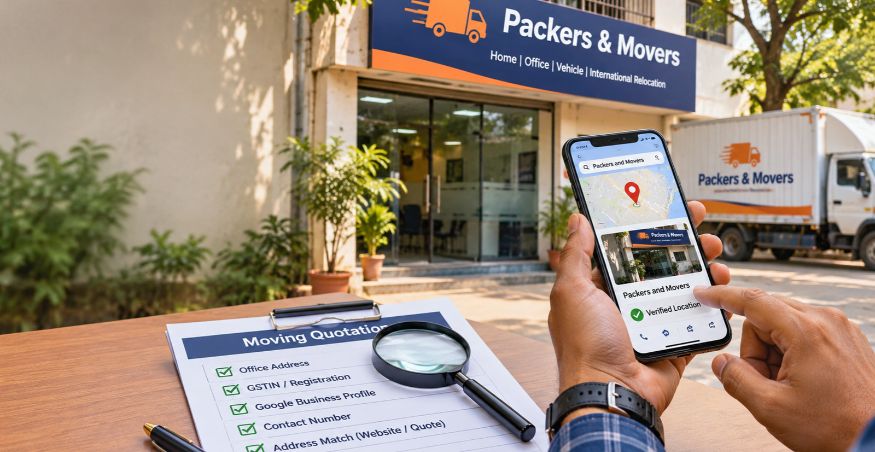
Moving scams take different forms, but a fake office address is one of the ways dishonest operators make themselves look like established businesses. A company might advertise a corporate office that turns out to be a residential flat, an empty plot or premises occupied by an entirely different business. Its website may look convincing, and its sales representative may answer every call. The address, however, tells a different story.
The problem often comes to light after the customer has paid an advance. By then, the company may stop answering calls, change its contact number or disappear altogether. If the movers have already collected your belongings, getting them back can become even more difficult.
You can avoid some of this risk by checking the company’s office address before agreeing to the move. Allow around 20 to 30 minutes for the basic checks. You’ll need the address from the quotation, the company’s registered name and its GSTIN, if applicable. A few searches and a phone call can reveal discrepancies that you might otherwise miss.
People often overlook this step because there’s already plenty to arrange before a relocation. You may be dealing with packing dates, school admissions, rental agreements, utility connections and the handover of your old home. Even so, it’s worth checking where the moving company actually operates before transferring any money.
Why It Is So Important to Verify Addresses
With a verifiable business address, you have a way of contacting the moving company if a dispute arises. It also allows you to verify whether the business operates from the premises it has advertised.
This is especially important if you are planning to move from one city to another. Customers often pay some money in advance before the movers come to pick up their belongings. This can be a large part of the total quotation, depending on the company’s terms. If the business takes the payment and disappears, it can take a lot of time to trace the people behind it.
An office address also gives you something to compare against other documents from the company. The address on the website may not match the address on the quotation, GST registration or company records. There are good reasons for these differences. A moving company may use one address for registration and another for its warehouse. The company should be able to explain the arrangement clearly.
Think of a small moving company that uses a warehouse on the outskirts of a city, but does billing from a separate office. Both addresses may be real. Find out which premises deal with customer enquiries, where the company keeps packing materials and which address it uses on its official paperwork.
If you need to visit the office, collect documents or raise a complaint, the difference matters. A business that can’t explain its own address details gives you little reason to proceed with confidence.
Start with Google Maps and Street View
Google Maps is a sensible place to start. Enter the full office address provided by the moving company into the app or website. Verify the location of the pin and the surrounding area against the description in the quotation.
If the location is in Street View, check out the building. Does it look like an office complex, warehouse or commercial property? Is there a shopfront or signboard with the company’s name? If the mover says they have a big warehouse, does the place fit that description?
Some details deserve closer attention:
- The address leads to a residential flat, although the company says it has a commercial office.
- The map pin is a number of streets away from the address given.
- There is a signboard for an unrelated business on the building.
- It looks like an empty plot or a closed property.
- The company says it has a warehouse, but the address is a small residential home.
Don’t dismiss a mover simply because its premises look modest. Many small operators work out of rented offices or shared commercial space. What matters is not the size of the premises, but whether the business actually operates there.
It’s worth remembering that Street View also has a limitation. Google doesn’t update every location on a regular basis, so the photographs may depict a building as it looked several years ago. A missing signboard or an old photo doesn’t prove the address is false. If the location raises questions, call the company and ask it to confirm the current premises.
Cross-Check the Google Business Listing
Google the name of the moving company and see if a Business Profile appears. Check the address on the listing against the address on the company’s website and quotation.
Check the name of the business carefully. A company may trade under a name different from its registered legal name, especially if it operates as a proprietorship or uses a separate trading brand. If you cannot make the connection yourself, ask for the registered name.
The review history can offer some background. Look at the dates, not just the overall rating. A profile with reviews over several years gives you a longer history to review. If most of the reviews were posted within a few days, look for other information before deciding whether they are real.
Read some of the reviews too. Do customers mention actual relocation work such as packing their households, collection of vehicles, delays in delivery or damage claims? Reviews that repeat almost identical phrases or give little detail should count for less.
Photos can help you inspect the premises. Search for images of the office, warehouse, staff or company vehicles. If you only see generic pictures of cartons and trucks in a listing, you can’t learn much about the actual business.
Google Business Profiles do not constitute proof of registration or business activity. Companies can move, forget to update old listings or operate without a public-facing profile. Use the information to find out where the details differ, and follow up with other sources.
Verify Through Government Registration Records
Government records are one more source to check what a mover says. What records you can use will depend on the type of business and the services it provides.
Ask for the company’s registered legal name first. If it is a private limited company or limited liability partnership, you can check the Ministry of Corporate Affairs (MCA) database. Check the registered office address and ensure it matches the details on the quotation.
And remember, not all moving businesses require MCA registration. For example, a sole proprietor does not register as a company under the Companies Act. So not being on the MCA database doesn’t necessarily mean that the business is fraudulent. First, establish its legal structure.
Another useful check is GST registration. If the mover has a GSTIN, then enter it on the official GST portal and verify the registration details. The record includes the registered business name and principal place of business. Cross-check with the invoice and quotation.
If the address is different, ask the company to explain why. It could be from a different branch or warehouse, or it might have just moved. You should be able to identify which address belongs to the registered business and which one is used for day-to-day operations.
Not all small movers will necessarily have a GSTIN. Registration requirements will depend on the business and the applicable GST rules. If the company says it is registered, what matters is whether it has provided a valid registration number.
You can also ask about vehicle ownership if the mover claims to have its own fleet. Ask for the registration numbers of the vehicles that will be carrying out your move. If the vehicle details are available in the public domain, then cross-check the details on the official VAHAN portal or the respective transport department.
Just because a person registers a truck in their name doesn’t mean it’s fraud. The company can either use leased vehicles or work with transport contractors. Ask who the vehicle belongs to and whether the arrangement is part of the agreed service. If the mover said they would use company trucks, then they need to be able to prove it.
Call Before You Commit, Not After
A phone call can answer questions that online searches don’t. But don’t just rely on the number in an advertisement or the contact information given by a sales representative.
Try to find another contact number on the company’s website, official paperwork or business listing. If there is a published landline number, call that separately. Ask the person answering to confirm the office address and clarify where the customer service or operations team is located.
Keep the questions straightforward. Ask for the name of the building, the floor number, the nearby landmark and whether the premises are an office or warehouse. You can also ask if customers can visit during business hours.
Check to see if the answers match what you’ve already gathered. If the sales representative gives you one address and the office contact gives you another, ask which address should be on your contract.
A mobile number isn’t suspicious. Many small moving businesses use mobile phones because they don’t have a separate landline. The worry is when the company refuses to give any verifiable address or is unable to explain basic details about its premises.
Don’t judge a business by how confidently someone answers the phone. Just because a company gives you an address doesn’t mean they operate from that address. A polished sales pitch proves nothing. Check the details with its documents.
Visit the Office If Possible
If you’re arranging a complete household relocation, an interstate move or an office transfer, visiting the mover’s premises can answer questions that a phone call cannot.
You don’t need to find a large showroom with reception staff and display areas. A modest office or warehouse can serve a legitimate moving business. Look for signs of regular activity. There may be employees handling customer enquiries, packing supplies stored inside, paperwork relating to current moves or vehicles associated with the company.
If you’re moving between cities and cannot visit yourself, ask a friend or family member who lives nearby to check the address. Share the exact location and the company’s name so they know what to look for.
During the visit, check whether the company name appears on the signboard or directory. Ask someone at the premises whether the business operates there. If the address belongs to a shared office, find out whether the company has a registered workspace or simply uses the location for correspondence.
An empty office doesn’t prove that the company is fraudulent. You might arrive outside working hours or find that the staff work from another branch. Call ahead and arrange a visit before travelling.
Pay attention to the answers you receive if the address belongs to another business. There may be a genuine connection, such as a shared office or warehouse arrangement. The mover should explain it and provide the relevant details in writing.
Watch for These Particular Red Flags
Some address-related problems deserve more attention than others. Look out for the following:
- The company refuses to provide a complete office address.
- Its website, quotation and official registration records show different addresses, with no clear explanation.
- The address leads to a property occupied by an unrelated business.
- The company claims to operate a warehouse but cannot identify its location.
- The GSTIN belongs to a different business or shows unrelated registration details.
- The mover refuses to include its business address on the quotation or contract.
- The company insists on an advance payment but avoids answering questions about its registered premises.
- Its representatives provide different addresses whenever you contact them.
One discrepancy doesn’t necessarily mean the mover is dishonest. A business may have relocated, changed its trading name or started using a separate warehouse. Small operators may also have limited online information.
The important thing is how the company responds when you ask for clarification. If it supplies the correct documents and explains the difference between its registered office and operating premises, you can assess the information on its merits.
Several unexplained inconsistencies are a different matter. Don’t rush into paying an advance while basic details remain unclear. Give the company an opportunity to provide the information, then decide whether you have enough evidence to proceed.
Putting It All Together
You can complete most address checks without leaving home. Start with Google Maps, examine the Business Profile and compare the address with the company’s official records. Call the mover if you find a difference. For a large relocation, arrange a visit if the premises are within reach.
Keep copies of the quotation, GST details, registration information and any written explanation the company provides about its addresses. If you later need to raise a complaint, these records will help establish which business you hired and what information it gave you before the move.
A company that has recently changed premises should have no difficulty explaining the change. The same applies to a mover that uses a registered office for billing and a separate warehouse for operations. Ask for the relevant addresses and make sure the contract identifies the business responsible for your relocation.
Address verification won’t tell you everything about a moving company. You still need to examine its quotation, insurance arrangements, payment terms and track record. However, it gives you a practical way to check whether the business you’re dealing with has a genuine and traceable presence.
Make these checks before paying the advance. Once the movers have collected your belongings, resolving an address dispute becomes considerably more difficult.

A copywriter, blogger, content strategist by profession, and an information junkie by heart. I have a penchant for reading, researching, writing, and anything related to creating persuasive content. For me, writing is something that ignites my creativity and helps in keeping me on cloud nine. I have been working in the content writing domain since 2006. Be it blogging or copywriting, I create better content that fuels conversations and skyrockets search traffic.