

Moving into a new house sounds really exciting in theory. New walls, new neighborhood, better opportunities, maybe a bigger kitchen, or that long-awaited balcony with a decent view. But if you’ve actually moved house in India, you know the reality is less glamorous than the fantasy in your head.
House shifting is more than packing boxes and hiring movers. It is an emotional, financial, and logistical marathon and will test your patience in ways you never imagined. There are hundreds of things nobody warns you about in advance, from unreliable packers and missing utensils to society bureaucracy, traffic delays, and the quiet exhaustion of taking apart a life you built one piece at a time.
If you are planning to move sometime soon, this guide will prepare you for the realities that most people only learn about after the chaos has already begun.
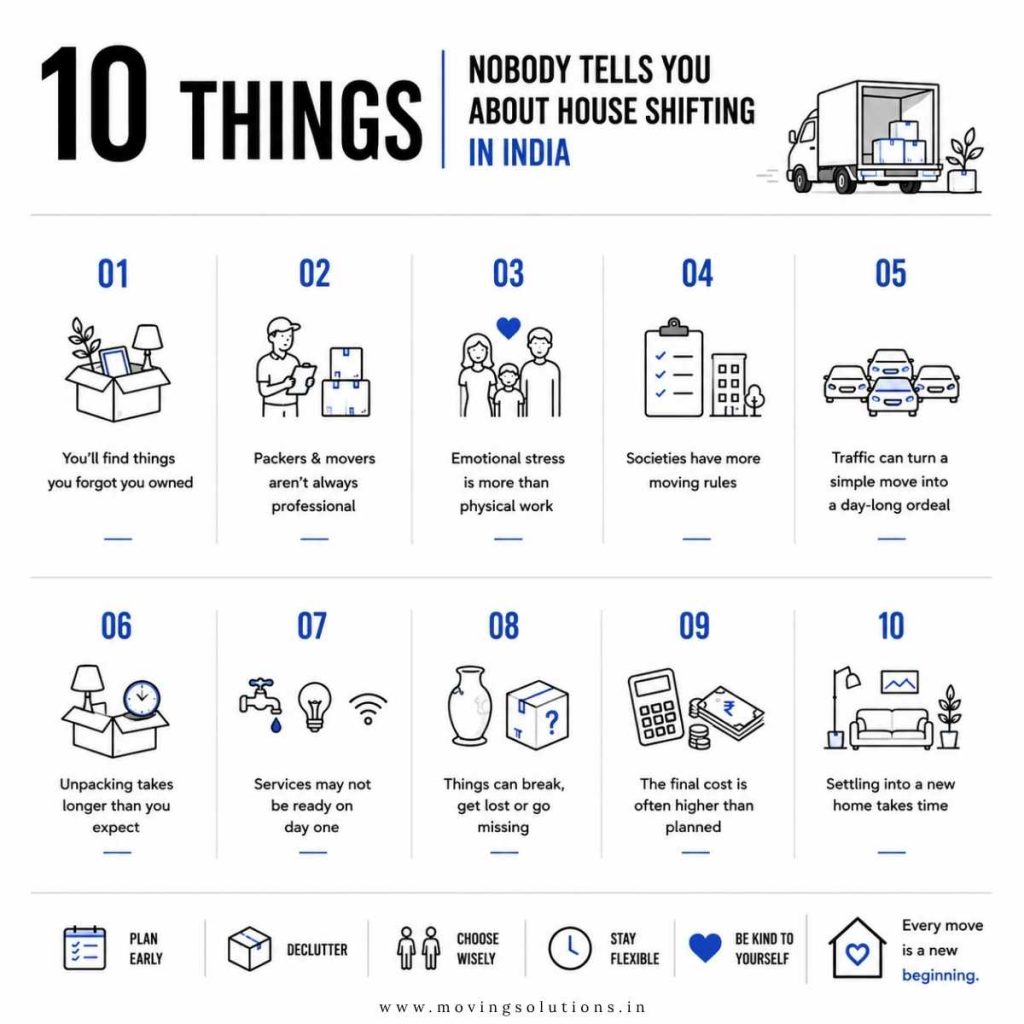
1. You Will Find Things You Forgot You Owned
The second you start packing your house is a full-blown archeological dig. Old phone chargers for phones you no longer own, unopened wedding gifts from years past, expired medications, lonely socks that have no mate, and miscellaneous keys that open absolutely nothing. That broken mixer you kept telling yourself you’d get fixed someday. Open a drawer or peek into a forgotten shelf, and it all comes out.
In most Indian homes, the “might be useful sometime” items pile up for years without anyone taking notice. Moving forces you to confront not only how much stuff you have, but how emotionally attached you’ve become to utterly useless things. You will spend a good twenty minutes deciding whether to bring empty plastic containers, old newspapers, extra steel utensils, cables from dead electronics, or clothes you haven’t worn in five years.
What is surprising is not the number of things you own, but how difficult it is to part with the things that no longer really serve a purpose in your life. Moving house makes you confront hoarding habits you didn’t know you had.
Before packing, make three simple piles — keep, donate, and throw away. Decluttering before you move will reduce your moving costs significantly and make unpacking on the other end a lot less overwhelming.
2. Packers and Movers Are Not Always as Professional as Advertised
Every packers and movers company promises safe delivery, expert handling, on-time service, and a completely hassle-free experience. The reality is far more diverse than those shiny websites and brochures would have you believe. Some companies are really good. Others subcontract their labor at the last minute, hire poorly trained workers, or quietly inflate costs once your belongings are already on the truck.
Common problems people encounter are late arrivals, damaged furniture, missing items, broken electronics, poor-quality packing, and charges that were never mentioned in the original quote. The moving industry is largely unorganized in many cities in India, and even well-reviewed companies can be a disappointment depending on the local team that actually shows up on the day.
The single most important thing nobody tells you: the cheapest quote is seldom the cheapest experience. Read recent reviews carefully, get a written and itemized quotation, check GST details, and see what the insurance actually covers. Take clear pictures of expensive or fragile things before handing them over to the movers. And never ever load valuables such as jewelry, important documents, laptops, medicines, and cash in the moving truck, no matter how trustworthy the company seems. Always keep these items with you personally at all times.
3. The Emotional Stress Is More Than the Physical Work
People greatly underestimate the emotional impact of changing houses. A house is more than a building; it silently holds years of living. Celebrated festivals in the living room. Family fights that you forgot about eventually. Birthdays. Late-night talks. Bad phases that you barely survived. And perfectly normal Tuesday evenings that somehow become unforgettable.
It can be strangely unsettling to take your home apart room by room, even if you are really excited about where you are going.
Children may find it more difficult than adults think. Older parents often resist change in difficult-to-navigate ways. Even pets can display visible signs of anxiety during relocation. No one talks enough about the decision fatigue and emotional exhaustion that quietly build up over the days around a move. It is perfectly normal to have mood swings, irritability, and a constant low-level anxiety during this sort of transition.
When you acknowledge that the stress is real — rather than just pushing through it — it gets much easier for everyone involved.
4. Indian Societies Have More Moving Rules Than You Think
If you are moving into or out of an apartment society in India, prepare yourself for a surprisingly organized layer of bureaucracy that most first-timers are totally unprepared for. Depending on where you live, you might need gate passes, lift booking confirmations, security deposits, no objection certificates, or formal vehicle entry approvals just to get started. Many societies restrict shifting to certain hours of the day, and prohibit movement altogether on certain weekends or public holidays.
And if your movers are late, because of traffic or anything else, your entire carefully orchestrated schedule can fall apart very quickly. The ones who are always the most surprised are the ones who thought they could just show up with a truck and go to work.
Always plan with the society office, security guards, building manager, and your landlord well before moving day. Also, schedule any electrical or plumbing work that needs to be done in your new home in advance. One missing approval can stall an otherwise well-organized move, and chasing down permissions on the day itself is genuinely stressful.
5. You Will Spend More Money Than Planned
Almost everyone underestimates the real cost of shifting houses, and almost everyone regrets not planning for it better. Along with the packers and movers invoice, there are dozens of costs that crop up without any notice – deep cleaning costs for the new house, paint touch-ups, curtain fittings, appliance installation costs, food orders on shifting days because nobody has time to cook, tips for the workers, and small repairs that just can’t wait.
Then there are the small purchases that somehow add up to a surprisingly large number. New buckets, extension cords, storage racks, bathroom accessories, organizers for kitchen shelves that are a different size than the ones you had before. The first month after a move is almost always a drain on your finances, no matter how well you planned the move itself.
The best thing you can do before you move is to create a separate budget for “unexpected expenses” (in addition to your main shifting budget). You’ll use it. This is not pessimism; this is just how house shifting in India works.
6. The First Night in the New House Feels Strange
Nobody prepares you for that awkward first night in a new place. Your mattress may still be in plastic. It is almost certain that the Wi-Fi won’t be up and running. Half the boxes are still taped, and you can’t find the toothpaste, the towel, or the fan remote. The day has completely exhausted you, but you can’t fall asleep because everything around you is strange and a little confusing.
Even the sounds are different — traffic patterns outside, dogs barking at different intervals, neighbors walking overhead, water pumps running at hours of the night. Sleeping in a new space with chaos all around and a mountain of cardboard, there is a particular type of emotional emptiness. That feeling is completely temporary, but it is real, and it takes most people by surprise. But within a few days, the familiarity starts to creep back, and the house starts to become a home in ways you can’t entirely plan for.
7. Unpacking Takes Far Longer Than Packing
Packing is generally a frantic, exhausting day or two, fueled by deadline pressure and adrenaline. Unpacking, on the other hand, can take weeks. Many Indian homes have boxes that last for months after a move, sitting in a corner with their contents permanently forgotten, occasionally used as makeshift surfaces for things that don’t have a proper place yet.
You unpack the essentials first — clothes, kitchen stuff, bedsheets, toiletries — and life just resumes straight away. The office work, school runs, daily errands, and traffic all rush back, and suddenly those “temporary” cartons feel like they have simply taken up permanent residence in the room.
The root problem is decision fatigue. Your brain is like, ‘Nah, not more of this crap’ after hundreds of decisions during the shift itself. You want to try to empty out one room at a time before moving on to the next room. You do not want to work in half-assed progress all over the house.
8. Your Domestic Setup Gets Completely Disrupted
Moving house throws a spanner in the works of every daily system you had going smoothly without a thought. Your new address is unknown to the milkman. The maid is not there or does not want to go to another neighborhood. The transfer of the gas connection takes longer than anyone promised. The internet installation gets delayed by a week. You have to service the water purifier before it is usable, and you’re stuck buying bottles in the meantime.
Simple, everyday things, like cooking a meal, doing laundry, finding the nearest grocery store, or figuring out the garbage disposal, suddenly seem unnecessarily complicated and all the more frustrating when you’re already tired. And if you work from home, the disruption is even more profound, because your professional routine is affected along with everything else.
Prepare a checklist well in advance before you move. This should include your Wi-Fi transfer, LPG connection, electricity meter reading, newspaper and milk subscriptions, maid arrangements, etc. These small logistical details are very quick to plan ahead of time, but lead to a lot of unnecessary frustration when not dealt with.
9. Neighbors Matter More Than the House Itself
Most people spend a lot of energy worrying about square footage, interior finishes, parking availability, and rent negotiations. But once they move into a new place, a lot of people find that their actual lived experience is much more determined by the neighborhood and the people who live there than by any specific feature of the house itself.
You might be dealing with regular noise from a particular floor, ongoing water issues, heated parking debates in the morning, or a messy common area that no one takes ownership of. Or you could end up with some real, warm, helpful neighbors who make the whole process of settling in feel a lot less overwhelming than it could otherwise have been.
If you are thinking of a new place, visit the area at different times of the day – weekday morning, weekend evening, and if possible, late night. You’ll see things that no online listing, brokerage website, apartment tour, or enthusiastic broker will ever tell you. If you give it the time to talk, the place speaks for itself.
10. House Shifting Teaches You What Actually Matters
Somewhere along the moving process, usually in the thick of the most chaotic part of it, something inside changes. If the cushion covers match, you don’t worry. No need to fret over perfect shelf placement or decorative accents. When the dust and fatigue have settled, you are left with a much clearer sense of what matters in daily life: peace, functional spaces, helpful people around you, and a stable routine that gives the day some shape.
House shifting strips you down to the bare essentials of life in a way that very few other experiences can. And then quietly and without any great fanfare, things begin to rebuild themselves. Back to our usual corner for morning tea. Familiar smells return. Family conversations are back on track. And the new place begins collecting its own memories — slowly, naturally, without any effort on your part.
Closing Thoughts
Moving house in India is chaotic, expensive, emotionally draining, and almost never goes to plan. Something will break. Something will go missing. Someone will get overwhelmed. The timeline will change at least once. That is just part of the process, and no amount of planning can ever totally eliminate it.
But months later, after the boxes are gone, the rooms have found their character, and the new place finally feels like yours, the chaos becomes just another story you tell over evening chai. If you’re planning a move, plan the logistics carefully — but prepare yourself mentally just as much. Because moving house is never just about the address. It’s about rebuilding your entire sense of home, one small and mundane thing at a time.

A copywriter, blogger, content strategist by profession, and an information junkie by heart. I have a penchant for reading, researching, writing, and anything related to creating persuasive content. For me, writing is something that ignites my creativity and helps in keeping me on cloud nine. I have been working in the content writing domain since 2006. Be it blogging or copywriting, I create better content that fuels conversations and skyrockets search traffic.